
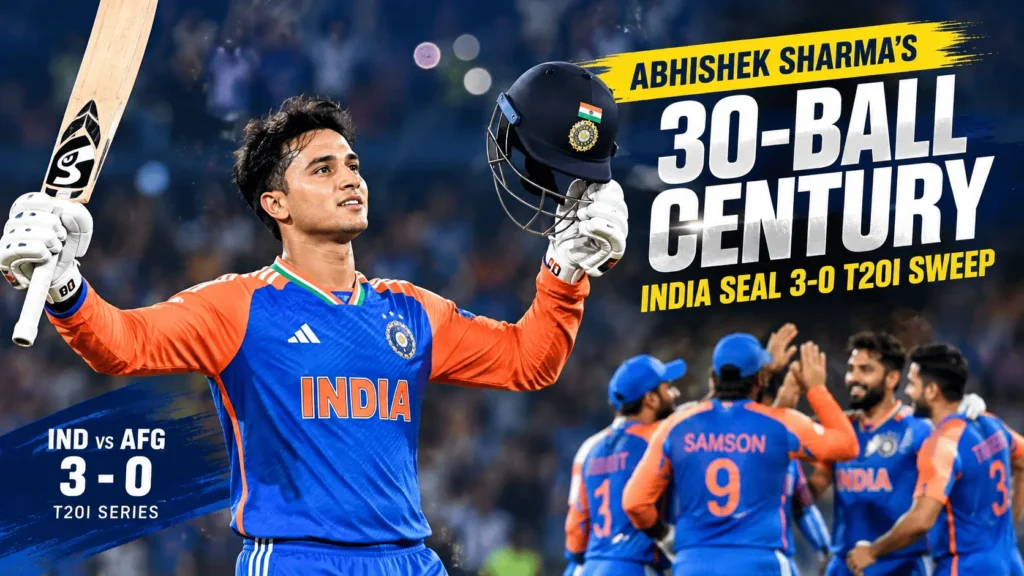
The main story was Abhishek Sharma’s 30-ball century as India ended a 3-0 T20I series sweep over Afghanistan in Delhi. The left-handed opener struck the fastest T20I century for a player on a full-member team. After reaching his century in just 30 balls, he scored 108 from 34 balls. Cricmatch brings you that exciting story.
The game took place at the Arun Jaitley Stadium. India scored 221 for seven after being told to start batting first. Afghanistan then fell at 14.1 overs to 94. India won by 127 runs and finished the three-match series unbeaten.
The triumph also came from an excellent team effort. Sanju Samson finished with 35 balls and ran 50. Then Nitish Kumar Reddy and Ravi Bishnoi took three wickets each as the search stalled.
Abhishek Sharma’s 30-ball century lays the groundwork.
Abhishek Sharma wanted to begin attacking with one basic aim in mind. Quickly, he found his rhythm. With his strong bat swing, the opener sent the ball flying across the boundary and into the gaps. The bowlers also gave him room; therefore, he dropped the pitch. Soon the score began rising quickly.
Abhishek Sharma’s 30-ball century came during the first 10 overs. That rendered the knock even more amazing. Cricbuzz claims he was the first batsman to record a T20I century inside the first 10 overs of a game.
His last knock was 108 from only 34 balls. Among them were nine fours and eleven sixes. His strike rate was 317.65.
Abhishek Sharma’s 30-ball century exceeds a major limit.
The rate of the hundred was remarkable.
In 30 balls, Abhishek reached three figures. That made it a full-member team player’s quickest T20I century. He passed the earlier 33-ball mark in T20Is set by Rohit Sharma. The innings offered more than only the total.
He smacked 102 of his 108 runs in limits. That came from nine fours and eleven sixes. It demonstrated from the beginning how much strain he put on the bowlers.
Abhishek sat on the pitch once he reached his hundred and removed his helmet. He closed his eyes and briefly meditated. Following one of the most forceful knocks of the series, it was a quiet memorial.
Abhishek Sharma’s 30-ball century transforms the game.
The starting burst provided India a vast foundation. Still, Abhishek wasn’t by himself. Staying with him, Sanju Samson contributed a helpful 50 off 35 balls. They collaborated to enableIndia too create a respectable total.
India still had enough time to contribute more runs even after Abhishek was dismissed for 108. From 20 balls, Shreyas Iyer made 29. Shivam Dube contributed 14 from 10. Ishan Kishan scored ten off eight balls. India ended in 20 overs on 221 for seven. That start afforded Afghanistan a challenging challenge. Supported by an excellent team effort, Abhishek Sharma’s 30-ball century
Though the opener drew the most attention, the bowlers were also very important.
Afghanistan had to get off to a good chase start. Rather, wickets arrived early. Three wickets fell from the team in the first two overs. That raised the goal’s degree of difficulty even further.
India maintained the strain.
Jasprit Bumrah made an early part of the pursuit strike. Yash Thakur also contributed a wicket. Ravi Bishnoi and Nitish Kumar Reddy then went through the middle order.
Nitish ended with three wickets taken for 25 runs. Additionally three for Bishnoi went twenty-six. Their magic reduced Afghanistan to 82 for 8.
India’s 221/7 gives the bowlers space. The bowlers had a lot of leeway with their 221 score. For most of the chase, the goal implied Afghanistan needed more than 11 runs every over. Given the early wickets lost, that is a difficult assignment.
The Indian bowlers persisted in targeting the stumps. They also limited the chances for the hitters to get simple runs.
The chase therefore never really sped up.
In 14.1 overs, Afghanistan were 94 all out. India triumphed with 127 runs.
Afghanistan’s worst loss by runs in T20I cricket as well was the 127-run margin. Their prior lowest score versus India was 111 for 8.
Abhishek Sharma’s 30-ball century completes a big series.
The third match was not the only time Abhishek made an impact. In the first T20I, he hit 82 from 32 balls. After that, in the second match,h he hit 39 off 19 balls. He made his tenth game off in 34 balls. He got 229 runs across the three games.
He ended the series with an average of 76.33. Additionally, his scores showed a distinct trend. He attacked starting from the opening overs and maintained pressure on the bowlers.
His performance in the last game won him both Player of the Match and Player of the Series trophies. The implications of Abhishek Sharma’s 30-ball century for the opener The knock also showed why aggressive opening can change a T20 match very quickly.
Abhishek did not wait for the innings to finish. Early, he sought scoring opportunities instead. From the fast bowlers, he attacked weak balls and utilised his feet against spin.
His post-match comments also indicated planning. He claimed his approach was grounded in examining the bowlers and determining their strategy for the overs that follow the powerplay.
That small fact is significant.
Big scores can appear easy when they occur. Still, they typically stem from a well-thought-out strategy. Abhishek’s performance made it clear he knew which balls he wished to hit.
An Abhishek Sharma full series
The series numbers chronicle the narrative.
- 229 runs in three games
- 108 off 34 balls in the last game
- Reached 100 off 30 balls
- 11 sixes in the last inning
- Last innings had nine fours
- 76.33 series average
- India finished the series with a 3-0 result.
These data also illustrate the relevance of the opener for the series outcome.
Concurrently, the outcome was not dependent on one batter only. Samson’s fifty helped in the last game. The bowlers then sealed the task with regular wickets. Abhishek Sharma’s 30-ball century guarantees a memorable ending. The series was clearly over after the last game.
India scored 221 for seven. Afghanistan couldn’t create a sustained relationship during the hunt. The visitors were dismissed for 94, India winning by 127 runs.
Abhishek Sharma’s 30-ball century will be the main topic of discussion for Cricmatch readers. Still, the overall outcome points to a bigger picture. The opening gave an explosive beginning. The middle order added sensible runs. Then the bowlers maintained their control of the pursuit. That combo helped India to finish a 3-0 sweep.
Abhishek’s 108 will still be the match’s best performance. More significantly, his 229 runs over the series established him as the three-game top run-scorer.
The Delhi night came to a record, a significant team victory, and a memorable century. For Abhishek Sharma, it also reminded him vividly of the results of preparation, timing, and attacking intent working together.