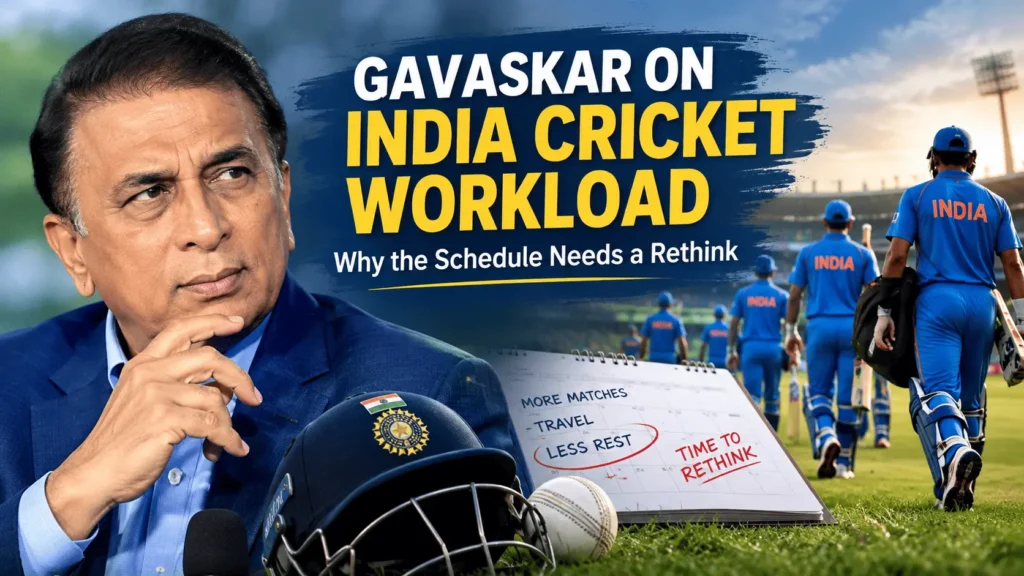
After the former captain raised worries about the congested cricket schedule, Gavaskar’s India cricket workload has become a major topic of discussion. Sunil Gavaskar hopes the schedule will be reexamined by the International Cricket Council (ICC). He believes players should have more time to recover from extended stretches of games.
In a recent Sportstar column, the ex-opener offered his thoughts. His remarks followed mounting worry regarding injuries and the demanding match schedule top players experience. Gavaskar claimed cricketers cannot be seen as machines capable of continuous work free from interruption.
The issue is not only about rest. It is also about the health of the wider cricket system. Gavaskar believes domestic cricket must get more care. He also feels that a strong national team can only come from a strong base.
Gavaskar on India cricket workload and the need for more rest
The main point in Gavaskar’s message is simple. Players need enough time to recover. Modern cricket can demand long travel, many matches and regular training. Players may also move between different formats in a short span. As a result, the body and mind may not get enough time to recover.
Gavaskar has now asked decision-makers to look at this issue while planning the next international calendar. The ICC is due to discuss the next cycle of international fixtures. Gavaskar hopes player health will be part of that discussion.
Gavaskar on India cricket workload and player health
Player health should be a major part of any cricket schedule. A tired player may find it harder to train, travel and perform at the required level.
Also, injuries can affect more than one match. A player who misses a series may need more time before returning to full strength. Then, another player must take that place.
This can create a cycle of change.
For that reason, rest should not be seen as lost cricket time. Instead, it can help players stay ready for important matches.
Gavaskar’s comments also come as the national side deals with several fitness concerns. Recent reports have linked the packed schedule with wider questions about player health and team balance.
Gavaskar on India cricket workload and the packed calendar
The cricket calendar has many demands. There are international series, domestic games and major events. Therefore, making room for every fixture can be difficult.
However, the answer may not be to keep adding more matches.
A better approach could be to study the full calendar before each cycle begins. Officials could then look at travel, rest periods and the number of matches played by key players.
This would also help teams plan.
Gavaskar’s view is clear. Players should not be pushed from one assignment to another without enough recovery time.
Gavaskar on India cricket workload and domestic cricket
Gavaskar’s argument goes beyond the national side. He believes the domestic system is the base of the sport.
The national team does not appear on its own. Players develop through local and first-class cricket before reaching the highest level. So, domestic cricket needs proper attention.
This point is important because a deep player pool is useful only when the system keeps producing skilled players.
A strong domestic structure can also give young players more chances to learn. They can gain experience against good opponents. They can also learn how to handle long matches and pressure.
Gavaskar has warned that giving less focus to domestic cricket could hurt the future of the sport.
Gavaskar on India cricket workload and the domestic pipeline
The domestic pipeline is where many future stars begin.
Players need regular matches to build their skills. They also need time in longer formats to understand patience, movement and game control.
Gavaskar has placed special value on red-ball cricket. He believes it gives players a strong base and helps prepare them for the demands of top-level cricket.
That means the focus should not stay only on the main team.
Instead, the full system needs support.
A healthy domestic structure can help create better players. It can also give selectors more options when injuries affect the main squad.
This is why workload and domestic cricket are linked. If senior players need more rest, younger players must be ready to step in. Those players need regular high-level cricket before that moment arrives.
Gavaskar on India cricket workload and a better way forward
Gavaskar has also raised questions about how the sport is managed. His view is that experienced people with knowledge of the game should have a bigger role in planning.
He pointed to older BCCI committees that included former players, umpires and administrators. He suggested that similar expert groups could help bring balance to the cricket system.
This idea could help with more than scheduling.
A group with different areas of experience could study player health, domestic cricket, fixtures and the needs of different formats. As a result, decisions may be made with a wider view.
Gavaskar on India cricket workload and the road ahead
There is no simple fix for a busy cricket calendar. Still, some steps can make a difference.
Give players proper gaps between demanding assignments.
Protect key domestic competitions.
Give young players enough first-class experience.
Study travel demands before setting schedules.
Use expert voices when planning the fixture list.
Review injury trends before adding more matches.
Keep player health in focus during calendar talks.
These steps can help create a better balance.
The goal is not to reduce the value of international cricket. Rather, it is to make sure players can perform at their best when important matches arrive.
For readers following cricket news through Cricmatch, this debate is worth watching because the schedule can shape team strength, player availability and future talent.
Gavaskar on India cricket workload: What his message means
Gavaskar’s message is bigger than one busy season. He is asking cricket leaders to think about the long-term health of the sport. A strong team needs fit players. Fit players need enoughrecovery. Future players need a strong domestic system. These points are closely linked.
The ICC calendar can therefore play an important role. If the schedule gives players enough space, teams may have more time to recover and prepare. At the same time, domestic cricket can continue to build the next group of players.
That could create a healthier cricket system from the top level to the grassroots.
For Cricmatch readers, Gavaskar’s comments offer a clear reminder: cricket needs players, but players also need time to rest. A full calendar may look exciting, but the people taking part in it must remain at the centre of every decision.
Cricmatch readers can also follow the latest cricket developments as the discussion around player workload and the future calendar continues.
For Cricmatch readers, Gavaskar’s comments offer a clear reminder: cricket needs players, but players also need time to rest. A full calendar may look exciting, but the people taking part in it must remain at the centre of every decision. A better balance can also help teams prepare for major events with a stronger and fitter squad.
This could then show more opportunities for younger players to show their abilities and develop. It can also keep seasoned players from too much strain across a long season. Therefore, the emphasis should be on quality, health, and long-term development instead of only more matches. If the cricket schedule is well designed, supporters, teams, and players would all profit. Cricmatch readers can also follow the latest cricket developments as this important discussion continues.