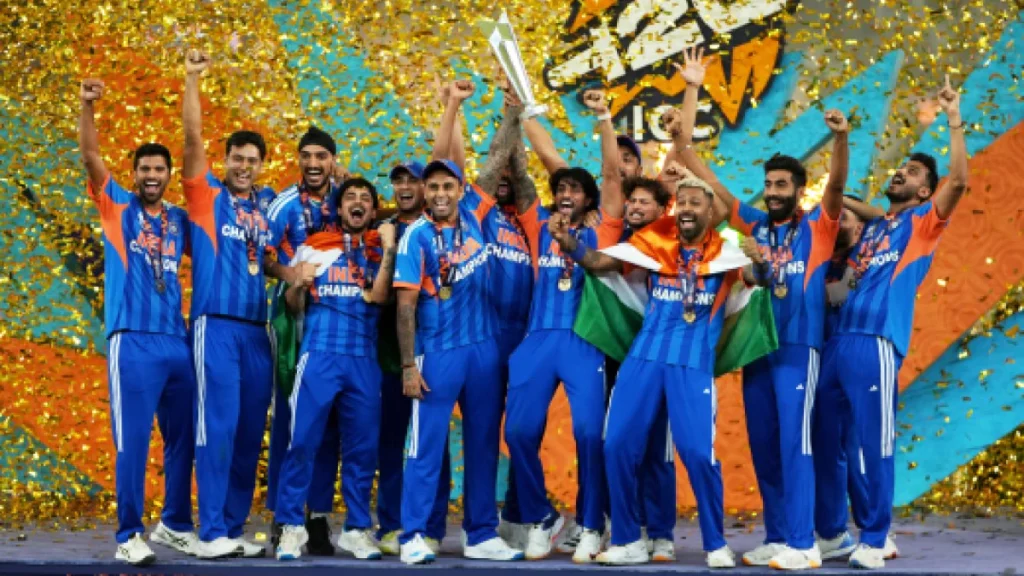
India made a stunning victory and beat New Zealand to secure the final of the 2026 ICC Men’s T20 World Cup that was hosted in Ahmedabad. The venue of the event, the Narendra Modi Stadium, had thousands of fans who were present to witness one of the greatest moments in the sporting history of India.
India began first and delivered a score of 255 in their 20 overs that was impressive. New Zealand was struggling trying to pursue the target, which was a challenge, and their innings came to an end with 159 runs in 19 overs.
India won easily by 96 runs, and this enabled them to retain their T20 World Cup championship, which they won in 2024.
India’s Batting Sets the Tone
Samson Leads the Charge
His aggressive batting style created the foundation for his team. He scored 89 runs off 46 balls because he controlled the game tempo, which helped his team reach their highest score in history.
Samson produced his best performance of the tournament at the perfect moment for his team. Samson used his strength to create an aggressive batting style, which maintained India’s batting speed throughout their entire match.
Blasting Backup by Top Management
Samson brought higher scoring rates because he was not the only player who drove the scoring rate up. In just 21 balls, Shama scored his half-century, giving a motivational boost to the team. At the same pace, with the aggressive batting, Ishan Kishan reached another fifty.
It was the highest T20 WC final score India has ever achieved. With this much run to chase, New Zealand faced increased pressure from the target, making it difficult to grab that cup.
New Zealand under Pressure
Powerplay Struggles
This pursuit of New Zealand did not start in very conducive conditions. India had gained heavily through the first few overs of the game with its openers; the New Zealand top order did not do the same.
By the end of the powerplay, New Zealand had fallen behind the necessary pace of scoring and lost major wickets.
With such a low run rate, it was hard for the team to chase the target. With the initial wicket, it became harder for the team to maintain a good run rate.
Shifting Resistance in the Middle Overs
New Zealand had tried to reorganise at some points. There was a half-century of some resistance by Tim Seifert, who gave some signs of a possible recovery.
Nevertheless, alliances never grew so long that they could pose a threat to the Indian dominance. The outcome was gradually sliding unreachable as wickets fell.
Bumrah Bowling Masterclass
Key Breakthroughs
New Zealand could never claim back the game because India had a bowling attack. Jasprit only gave 15 runs and took 4 wickets, which was the foundation of the team lifting the copy. .
Support from the Spin Attack
Another significant contribution was made by the ball by Axar Patel, who took three wickets in the pursuit. The bowlers of India collectively destroyed the line of the New Zealand and ended the innings earlier than the 20 overs.
The strict bowling work guaranteed that the game was completed with ease.
Emerging Chapter in the T20 History of India.
The victory of India in the 2026 final makes them one of the most powerful teams in the modern T20 cricket sector. Not only did the team retain the championship, but it presented one of the most bang-on performances to-date in a World Cup final.
The victory is an iconic moment for both the players and fans. It demonstrates how a measured blend of violent batting and disciplined bowling could result in success in the highest level.
Having snatched another trophy to their collection, the T20 journey of India now has a new step, which is that expectations in future tournaments will now be greater.